Wednesday, 12/3/14
Competition Squats
- 365x1 (added belt before this)
- 405x1
- 435lbs x 4 - PR +2 reps - had room for at least on more rep.
- 405lbs x 3
Wider Sumo Deadlifts - moving closer to competition stance.
- 365x1
- 405x1
- 455x1
- 475lbs x 3 - +10lbs PR at 3 reps
- 455lbs x 3
Thursday, 12/4/14
More Low Bar Competition Squats!
- 365x1 (belt is on at this point)
- 405x1
- 445x3 - PR!
- 425x3
- 405x2
Close Grip Bench (Paused)
- 225x1
- 235x5x4 sets - Felt fantastic, except for the last set. My elbows started to give me a little trouble at that point, which typically happens after a couple of low bar sessions. Still got the work in though.
Some random accessory stuff to finish out the day.
Friday, 12/5/14
Beltless Paused High Bar
- 365x1
- 375x2 - PR +1 rep
- 355x4 - PR +1 rep
Some accessory work, and done. Squats are going fantastically.
Saturday, 12/6/14
High Bar Squats w/ 4-count eccentrics
- 365x1
- 395x3 - +10lb PR
- 365x5 - new 5RM on this lift
All this despite feeling very crappy going in. The end of the week always feels very crappy for me, probably due to the accumulated volume throughout the week. Finished up with some rear delt work, some transverse ab work, and a little stretching of the external rotators and called it a day.
Sunday, 12/7/14
Front Squats
- 315x1
- 365xfail - bar was just not sitting in the rack like it should. Dropped it on the way down and said screw it.
- 315x2, 2
Called it a day. Kinda pissed off about the performance here. Positionally it just wasn't there today.
Monday, 12/8/14
Bench Press
- 225x3
- 245x3
- 270x3 - ties a PR triple
- 245x3
- 225x3
Some miscellaneous circuit work involving glutes, anti-rotational work, and hanging
Showing posts with label program design. Show all posts
Showing posts with label program design. Show all posts
Saturday, December 13, 2014

Wednesday, December 3, 2014
The Great Squat Experiment, Week 8
Josh Trammell
Lots of driving this week, which means I've had to do a lot more in the way of warm-ups to get ready for lifting. Still getting the work in though.
Wednesday, 11/26/14
Competition Stance Squats w/ Belt
- 365x1
Add Belt
- 345x1
- 385x1
- 405x1
- 420x5 - PR 5RM - I was expecting somewhere between 2-5, based on how the first two reps felt. Told the spotter the same. Turns out, the first 2 reps felt easy, the 3rd rep felt easy, the 4th rep felt easy, and the 5th was slightly grindy, but I had one more rep in me. Very, very, very happy with this PR. Biggest PR of the cycle, in my book.
Sumo DLs w/ Belt
- 365x1
- 405x1
Add Belt
- 405x1
- 465x3 - +10lbs PR - my goal is to just add 5-10lbs on my triples each week leading up to the meet on this day, eventually transitioning to heavy doubles, and max effort singles about 2 weeks out or so. Again, happy with this.
- 425x2 - hexagonal plates were rolling all over the place, whether it was into my shins or away from the body. I got pretty pissed at this point and just called it at 2 reps.
Friday, 11/28/14
Competition Stance Squats w/ Belt
- 365x1
Add Belt
- 365x1
- 405x1
- 435x2 - PR 2RM. Felt pretty crappy after long days of traveling and sitting down in a car. All the sitting down wrecked my hips and threw my groove off (again), but I managed to hit this on a pretty bad day, all things considered.
- 405x2
Close Grip Pause Bench
- 185x4
- 225x5x3 sets - fairly happy with this. Again, max is probably sitting around 270-275 or so. Some elbow pain, not quite as bad as last bench session though.
Saturday, 11/29/14
High Bar Paused Squats
- 365x1
- 365x2
- 345x3
This day felt like absolute crap. Came in and put in the work and called it a day.
Sunday, 11/30/14
Eccentric-Emphasis High Bar Squats w/ Belt
- 365x1
- 385x4 - +1 rep PR
Deficit Sumo Deads:
345 x 1,1,1,1,1
355 x 1,1,1
365 x 1,1
Playing around with this more than anything. Just an experiment. Tried to move bar as fast as possible off the floor.
Monday, 12/1/14
Front Squats
- 315x1
- 345x1
- 365x1 PR + 10lbs
- 345x2 - new 2RM PR
Week really thrown off, but I ended up with a couple of nice PRs.
Lots of driving this week, which means I've had to do a lot more in the way of warm-ups to get ready for lifting. Still getting the work in though.
Wednesday, 11/26/14
Competition Stance Squats w/ Belt
- 365x1
Add Belt
- 345x1
- 385x1
- 405x1
- 420x5 - PR 5RM - I was expecting somewhere between 2-5, based on how the first two reps felt. Told the spotter the same. Turns out, the first 2 reps felt easy, the 3rd rep felt easy, the 4th rep felt easy, and the 5th was slightly grindy, but I had one more rep in me. Very, very, very happy with this PR. Biggest PR of the cycle, in my book.
Sumo DLs w/ Belt
- 365x1
- 405x1
Add Belt
- 405x1
- 465x3 - +10lbs PR - my goal is to just add 5-10lbs on my triples each week leading up to the meet on this day, eventually transitioning to heavy doubles, and max effort singles about 2 weeks out or so. Again, happy with this.
- 425x2 - hexagonal plates were rolling all over the place, whether it was into my shins or away from the body. I got pretty pissed at this point and just called it at 2 reps.
Friday, 11/28/14
Competition Stance Squats w/ Belt
- 365x1
Add Belt
- 365x1
- 405x1
- 435x2 - PR 2RM. Felt pretty crappy after long days of traveling and sitting down in a car. All the sitting down wrecked my hips and threw my groove off (again), but I managed to hit this on a pretty bad day, all things considered.
- 405x2
Close Grip Pause Bench
- 185x4
- 225x5x3 sets - fairly happy with this. Again, max is probably sitting around 270-275 or so. Some elbow pain, not quite as bad as last bench session though.
Saturday, 11/29/14
High Bar Paused Squats
- 365x1
- 365x2
- 345x3
This day felt like absolute crap. Came in and put in the work and called it a day.
Sunday, 11/30/14
Eccentric-Emphasis High Bar Squats w/ Belt
- 365x1
- 385x4 - +1 rep PR
Deficit Sumo Deads:
345 x 1,1,1,1,1
355 x 1,1,1
365 x 1,1
Playing around with this more than anything. Just an experiment. Tried to move bar as fast as possible off the floor.
Monday, 12/1/14
Front Squats
- 315x1
- 345x1
- 365x1 PR + 10lbs
- 345x2 - new 2RM PR
Week really thrown off, but I ended up with a couple of nice PRs.
Sunday, November 30, 2014
The Great Squat Experiment: Week 7
Josh Trammell
Tuesday, 11/18/14
Still recovering from food poisoning, but I wanted to get in the gym and see what I could do. Wasn't going in expecting much - my goal was to come in, work up to 315-365, see how it felt, and if I felt like crap, leave, if I felt good, go a little heavier.
Low Bar Squats (Beltless)
- 365 x 1, 1, 1, 1 - was very out of the groove. A couple of adjustments plus just working at this weight loosened me up and things felt better. Felt good enough to move up.
- 385 x 1 - felt good, moved up
- 405 x 1 - felt easy
- 415x2 - new 2RM. No video, unfortunately. Wasn't prepared to set a PR after food poisoning.
Paused Low Bar
- 365x3
Called it quits. Who says you can't set PRs after getting sick and not eating much at all for 3 days?
Wednesday, 11/19/14
Low Bar Squats with a Belt
- 365 x 1 (add belt), 1,1
- 405 x 1
- 425 x 1
- 450 x 1 - PR +5lbs
Conventional Deadlifts w/ Belt
- 365x1
- 405x1
- 455x2 - PR 2RM - Not really KK/ Pete Rubish like. First time I've videoed these. Felt good though.
Sumo Deadlifts w/ Belt
- 365x1
- 405x1
- 455x3 - PR +1 rep
- 435x3
Thursday, 11/20/14
Felt very exhausted going on. That's why, typically, the day after deadlift days is a Pause squat to reduce absolute volume/loading and compression on the spine.
Pause High Bar Squats
- 355x1
- 375x1 - could've gotten 2, but it would've been a real grind. Decided against it.
- 355x3 - PR 3RM +10lbs I believe
- 315x3
Short ab/decompression/stretching circuit, and called it quits.
Friday, 11/21/14
4-second Eccentric High Bar Squats w/ Belt (That's a mouthful...)
- 365x1, add belt, 1
- 385x1
- 405x1
- 415x1
- 385x3
Not a particularly big fan of these, but I never work on the eccentric phase of the lift, so I figured it was time to do so. Plus, it is a nice change of pace.
Saturday, 11/22/14
Felt absolutely wrecked going into this session. Tired, worn down, not really ready to get a lift in, honestly.
Low Bar Squats w/ Belt
- 365x1 - add belt
- 345x1 - moved down to get my groove
- 385x1 - felt horrible
- 405x1, 1 - both sets felt awful. This is something I did earlier in the week, without a belt, with ease. Just called it quits here. Still got quality work in that 85%+ range, so it's all good.
Sunday, 11/23/14
Front Squats
- 315x1
- 355x1 +10lb PR. Haven't done these in like 6 or 7 months, so I was very pleased with the speed of this on camera. Also pretty obvious that there are some left-right differences in front rack flexibility from this video. Not very comfortable looking front rack, probably due to the fact that I just haven't done them in a while.
- 315x3 +40lb PR
'Speed' Sumo Deadlifts
- 345x 1 x 10 sets - about 60-90s rest between sets, focusing in on maximal velocity off the ground to lockout. Felt decent.
Paused Bench Press
Haven't been able to bench press due to elbow pain, but I got my compression cuff in, so I wanted to test it out.
- 225 x 3 x 3 sets - not too bad. Had a couple reps where the left elbow just gave out on me, but I'm still probably good for about 270 right now. Could've done all sets for 5 reps. Decently happy with that. Need to get my speed back, but everything else was fine.
Monday, 11/24/14
Remedial circuit and recovery work. Nothing of note to post about.
Tuesday, 11/18/14
Still recovering from food poisoning, but I wanted to get in the gym and see what I could do. Wasn't going in expecting much - my goal was to come in, work up to 315-365, see how it felt, and if I felt like crap, leave, if I felt good, go a little heavier.
Low Bar Squats (Beltless)
- 365 x 1, 1, 1, 1 - was very out of the groove. A couple of adjustments plus just working at this weight loosened me up and things felt better. Felt good enough to move up.
- 385 x 1 - felt good, moved up
- 405 x 1 - felt easy
- 415x2 - new 2RM. No video, unfortunately. Wasn't prepared to set a PR after food poisoning.
Paused Low Bar
- 365x3
Called it quits. Who says you can't set PRs after getting sick and not eating much at all for 3 days?
Wednesday, 11/19/14
Low Bar Squats with a Belt
- 365 x 1 (add belt), 1,1
- 405 x 1
- 425 x 1
- 450 x 1 - PR +5lbs
Conventional Deadlifts w/ Belt
- 365x1
- 405x1
- 455x2 - PR 2RM - Not really KK/ Pete Rubish like. First time I've videoed these. Felt good though.
Sumo Deadlifts w/ Belt
- 365x1
- 405x1
- 455x3 - PR +1 rep
- 435x3
Thursday, 11/20/14
Felt very exhausted going on. That's why, typically, the day after deadlift days is a Pause squat to reduce absolute volume/loading and compression on the spine.
Pause High Bar Squats
- 355x1
- 375x1 - could've gotten 2, but it would've been a real grind. Decided against it.
- 355x3 - PR 3RM +10lbs I believe
- 315x3
Short ab/decompression/stretching circuit, and called it quits.
Friday, 11/21/14
4-second Eccentric High Bar Squats w/ Belt (That's a mouthful...)
- 365x1, add belt, 1
- 385x1
- 405x1
- 415x1
- 385x3
Not a particularly big fan of these, but I never work on the eccentric phase of the lift, so I figured it was time to do so. Plus, it is a nice change of pace.
Saturday, 11/22/14
Felt absolutely wrecked going into this session. Tired, worn down, not really ready to get a lift in, honestly.
Low Bar Squats w/ Belt
- 365x1 - add belt
- 345x1 - moved down to get my groove
- 385x1 - felt horrible
- 405x1, 1 - both sets felt awful. This is something I did earlier in the week, without a belt, with ease. Just called it quits here. Still got quality work in that 85%+ range, so it's all good.
Sunday, 11/23/14
Front Squats
- 315x1
- 355x1 +10lb PR. Haven't done these in like 6 or 7 months, so I was very pleased with the speed of this on camera. Also pretty obvious that there are some left-right differences in front rack flexibility from this video. Not very comfortable looking front rack, probably due to the fact that I just haven't done them in a while.
- 315x3 +40lb PR
'Speed' Sumo Deadlifts
- 345x 1 x 10 sets - about 60-90s rest between sets, focusing in on maximal velocity off the ground to lockout. Felt decent.
Paused Bench Press
Haven't been able to bench press due to elbow pain, but I got my compression cuff in, so I wanted to test it out.
- 225 x 3 x 3 sets - not too bad. Had a couple reps where the left elbow just gave out on me, but I'm still probably good for about 270 right now. Could've done all sets for 5 reps. Decently happy with that. Need to get my speed back, but everything else was fine.
Monday, 11/24/14
Remedial circuit and recovery work. Nothing of note to post about.
Wednesday, November 19, 2014
The Great Squat Experiment, Week 6
Josh Trammell
Wednesday, 11/12/14
Wide(r) High Bar Squats w/ Belt
- 315x1 - Add Belt
- 315x1
- 365x1
- 405x1
- 415x3 - PR + 10lbs - around a 10 RPE though. Went a little too hard. Was pissed from the struggle all last week though.
- 385x3
Narrow Sumo + Belt
- 365x1 - Add belt
- 405x1
- 455x2 - ties previous PR at a narrower stance
- 425x3
Felt like crap, so I stopped.
Thursday, 11/13/14
Beltless Low Bar Squats
- 365x1
- 395x1
- 405x3 - Rep PR + 2 reps (also, PR + 20lbs)
- 375x5 - Rep PR +2 reps
Felt like crap, but it appears fast on video, so I'll take it.
Friday, 11/14/14
Birthday Pause Squats (low bar)
- 365x1
- 395x3 - PR + 40lbs (haven't done triples for weight in a while)
- 365x3
Saturday - Monday:
Ate at my favorite restaurant for my birthday, and managed to get food poisoning in the process. Thus, no training happened on any of those days.
Wednesday, 11/12/14
Wide(r) High Bar Squats w/ Belt
- 315x1 - Add Belt
- 315x1
- 365x1
- 405x1
- 415x3 - PR + 10lbs - around a 10 RPE though. Went a little too hard. Was pissed from the struggle all last week though.
- 385x3
Narrow Sumo + Belt
- 365x1 - Add belt
- 405x1
- 455x2 - ties previous PR at a narrower stance
- 425x3
Felt like crap, so I stopped.
Thursday, 11/13/14
Beltless Low Bar Squats
- 365x1
- 395x1
- 405x3 - Rep PR + 2 reps (also, PR + 20lbs)
- 375x5 - Rep PR +2 reps
Felt like crap, but it appears fast on video, so I'll take it.
Friday, 11/14/14
Birthday Pause Squats (low bar)
- 365x1
- 395x3 - PR + 40lbs (haven't done triples for weight in a while)
- 365x3
Saturday - Monday:
Ate at my favorite restaurant for my birthday, and managed to get food poisoning in the process. Thus, no training happened on any of those days.
Thursday, November 13, 2014
The Great Squat Experiment: Week 5
Josh Trammell
I will preface this log by saying I spent around 20 hours driving in a car from Monday - Wednesday afternoon. Hips were destroyed, didn't get any lifting in, generally felt like crap that first workout back. Anyway, here it is.
Thursday, 11/6/14
Beltless High Bar Back Squats
- 365x1
- 395 x miss (what the hell?) - hips shifted out behind the bar. Got pissed. Took another shot at it
- 395 x 1 - kept hips in a better position, less shifting, more lifting. Still pissed though
- 335 x 5
Friday, 11/7/14
Beltless High Bar Squats
- 365x1
- 385x1
- 405x1 - get recruited by powerlifting team, turn them down
- 365x3
- 315x3, 3-second pauses at the bottom of each squat, cause I felt like it
Conventional Deads (no belt)
- 365x1
- 405x1
- 405x5x3 sets - PR + 20lbs and 2 sets
- Starting to get the hang of conventional pulling. Took a while. Turns out my build favors a KK/Pete Rubish-ish type of pull. Almost enjoying conventional now, after hating it for so long.
Going to play around with 2 deadlift days: 1 conventional (for volume), 1 sumo, where the intensity will be upped. See how that goes along with all the squats.
Saturday, 11/8/14
Staying on the strugglebus...
Pause Squats - beltless
- 315 x 1
- 345 x 1
- 365x2 - PR +1 rep (cheap, I know)
- 335 x 3
Sunday
The strugglebus continues!
Beltless High Bar
- 365x1
- 385x1
- 405x1 - a little slower than normal, still haven't fully come back from that dang car ride.
- 365x3
- 315x3
Monday - Recovery/Pump Day
1A) Kossack Squat -> crossover Step-Up 3x12/leg
1B) Chest Flies 3x12 (5-10s eccentric for the stretch)
1C) Rear Delt Flies - 3x12
2A) Bar Hangs x a decently long time
2B) Bear crawls focusing on neutral spine and breathing
2C) Half Kneeling Chops - 3x8-10/side
Week 5 sucked.
I will preface this log by saying I spent around 20 hours driving in a car from Monday - Wednesday afternoon. Hips were destroyed, didn't get any lifting in, generally felt like crap that first workout back. Anyway, here it is.
Thursday, 11/6/14
Beltless High Bar Back Squats
- 365x1
- 395 x miss (what the hell?) - hips shifted out behind the bar. Got pissed. Took another shot at it
- 395 x 1 - kept hips in a better position, less shifting, more lifting. Still pissed though
- 335 x 5
Friday, 11/7/14
Beltless High Bar Squats
- 365x1
- 385x1
- 405x1 - get recruited by powerlifting team, turn them down
- 365x3
- 315x3, 3-second pauses at the bottom of each squat, cause I felt like it
Conventional Deads (no belt)
- 365x1
- 405x1
- 405x5x3 sets - PR + 20lbs and 2 sets
- Starting to get the hang of conventional pulling. Took a while. Turns out my build favors a KK/Pete Rubish-ish type of pull. Almost enjoying conventional now, after hating it for so long.
Going to play around with 2 deadlift days: 1 conventional (for volume), 1 sumo, where the intensity will be upped. See how that goes along with all the squats.
Saturday, 11/8/14
Staying on the strugglebus...
Pause Squats - beltless
- 315 x 1
- 345 x 1
- 365x2 - PR +1 rep (cheap, I know)
- 335 x 3
Sunday
The strugglebus continues!
Beltless High Bar
- 365x1
- 385x1
- 405x1 - a little slower than normal, still haven't fully come back from that dang car ride.
- 365x3
- 315x3
Monday - Recovery/Pump Day
1A) Kossack Squat -> crossover Step-Up 3x12/leg
1B) Chest Flies 3x12 (5-10s eccentric for the stretch)
1C) Rear Delt Flies - 3x12
2A) Bar Hangs x a decently long time
2B) Bear crawls focusing on neutral spine and breathing
2C) Half Kneeling Chops - 3x8-10/side
Week 5 sucked.
Thursday, November 6, 2014
The Great Squat Experiment: Training Log, Week 3 (or 4?)
By: Josh Trammell
*Note: This is a little over 3 weeks into the training cycle I'm currently in, experimenting with very high frequency, every-day max (EDM) style squatting. I won't go into the specifics of the plan here (future article will), but here's my log from the last week.
Previous videoed PRs:
385lb Belt Pause Squat x 1
Beltless, 415lbs x 1 High Bar Back Squat
Competition Stance Low Bar Squat 435lbs x 1 with a belt
445lbs x 1 Competition Stance Low Bar Squat, with Belt
Wednesday, 10/29/14
Beltless, Low Bar Back Squat:
- 365lbs x 1
- 395lbs x 1
- 420lbs x 1 - +5lb Beltless PR
- 385lbs x 4: +1 rep PR @ 385lbs
- 355lbs x 3
Thursday, 10/30/14
Beltless High Bar Back Squats
- 365lbs x 1
- 390lbs x 1
- 365lbs x 5 - +2 rep PR
Bench
- 225lbs x 1
- Elbow decided to crap out on me. Called it a day here. No use in aggravating it any more.
Friday, 10/31/14
- Beltless, Paused High Bar Squats
- 355lbs x 1
- 375lbs x 1 +10lb PR
- 385lbs x 1 +20lb PR
- 335lbs x 3 new 3 rep PR
Conventional Deads:
- 365x1
- 405x1
- Add belt: 405x5 (7 RPE)
Narrow Sumo:
- 365x1
- 405x1
- 455x1 - tied Beltless PR with a narrower stance. Oh, and I haven't pulled sumo in around 6 months
- 425x3 - 7 RPE
Sunday, 11/2/14
Safety Bar Squats
- 330x1
- 380x1
- Add Belt: 410x1 - +60lb PR
- 350x6 + 35lb PR
- no belt: 310x5
*Note: This is a little over 3 weeks into the training cycle I'm currently in, experimenting with very high frequency, every-day max (EDM) style squatting. I won't go into the specifics of the plan here (future article will), but here's my log from the last week.
Previous videoed PRs:
385lb Belt Pause Squat x 1
Beltless, 415lbs x 1 High Bar Back Squat
Competition Stance Low Bar Squat 435lbs x 1 with a belt
445lbs x 1 Competition Stance Low Bar Squat, with Belt
Wednesday, 10/29/14
Beltless, Low Bar Back Squat:
- 365lbs x 1
- 395lbs x 1
- 420lbs x 1 - +5lb Beltless PR
- 385lbs x 4: +1 rep PR @ 385lbs
- 355lbs x 3
Thursday, 10/30/14
Beltless High Bar Back Squats
- 365lbs x 1
- 390lbs x 1
- 365lbs x 5 - +2 rep PR
Bench
- 225lbs x 1
- Elbow decided to crap out on me. Called it a day here. No use in aggravating it any more.
Friday, 10/31/14
- Beltless, Paused High Bar Squats
- 355lbs x 1
- 375lbs x 1 +10lb PR
- 385lbs x 1 +20lb PR
- 335lbs x 3 new 3 rep PR
Conventional Deads:
- 365x1
- 405x1
- Add belt: 405x5 (7 RPE)
Narrow Sumo:
- 365x1
- 405x1
- 455x1 - tied Beltless PR with a narrower stance. Oh, and I haven't pulled sumo in around 6 months
- 425x3 - 7 RPE
Sunday, 11/2/14
Safety Bar Squats
- 330x1
- 380x1
- Add Belt: 410x1 - +60lb PR
- 350x6 + 35lb PR
- no belt: 310x5
Sunday, November 17, 2013
Have it all... and then some: perfecting Bryce Lane's 50/20
Aris DeMarco
Wondering what 50/20 is? part one
The prior entry detailed some of the strengths and weaknesses of the general 50/20 protocol. In short, the pros: simple, short workouts, extremely fast results, increases in strength/size/endurance across the board, and ideal for those who have minimal equipment. The cons: burnout comes quickly. This is really the only problem--you get stale and you get stale fast. So working with 50/20 becomes an effort to outrace your own progress with changing things up just enough to keep yourself moving forwards. Intelligent exercise choices, basic cycling plans, and carefully planned deloads can all help you get the most out of 50/20 (or any density training plan).
Wondering what 50/20 is? part one
The prior entry detailed some of the strengths and weaknesses of the general 50/20 protocol. In short, the pros: simple, short workouts, extremely fast results, increases in strength/size/endurance across the board, and ideal for those who have minimal equipment. The cons: burnout comes quickly. This is really the only problem--you get stale and you get stale fast. So working with 50/20 becomes an effort to outrace your own progress with changing things up just enough to keep yourself moving forwards. Intelligent exercise choices, basic cycling plans, and carefully planned deloads can all help you get the most out of 50/20 (or any density training plan).
I don't really have any relevant pictures to put up, so this blog will have random videos I've liked recently to keep you from being bored. Don't ever say I didn't give you anything.
So, exercise choices. Something Charles Staley, the progenitor of the original density training idea, advises is to use 'small' exercises the first time you go through a density program. "[It is] based on my preference to avoid technical or coordination-intensive exercises (such as squats or deadlifts) while in a "panicked" state of mind. In theory, this program can be done using more technical lifts as long as you remain 'present' or 'in the moment'." (The EDT workout he advises can be found here.) So, maybe the first time you try 50/20 or a similar routine, keep things light. Maybe stay away from full squats and C&Ps and stick to a split squat variant and then chins/dips, or something.
When you do want to load up and go for broke, something I've found is that lifts that begin with an eccentric are much more practical to use. The benefit of the stretch reflex should not be underrated, especially if you're trying to grind out 50 total reps of an exercise. Thus, choosing a bench variant (or perhaps push presses) over standing presses might be a good idea. RDLs are probably a better idea than conventional or sumo deadlifts, since breaking the weight off the ground every rep (or at least every set, if you're going touch-and-go) will just tear you up, believe me. Often, once fatigue sets in the concentric will be your limiting factor if you start with it, so pick lifts accordingly; starting with a negative will help you get more work done.
Chen Yibing. Lord of the Rings, right there.
Deloads. This is a big one with 50/20. Bryce advised going 3 on/one off in his original article. That is--do two, maybe three big lifts each twice weekly for 3 weeks, busting ass and trying for a new PR each time. Then, take your fourth week completely off. Alternatively, test your 1RMs on the fourth week, hopefully having gained something along the way. Pretty simple, but it can be a lifesaver. Staley advises stopping the density program and switching to a more Pavel-esque routine of 3-5x3-5, 3-5x/week, if you fail to break your PR twice after backing off a bit (check that article out here). The difficult thing here is making yourself deload; the PRs stack up so quickly and a 'challenging' weight will rapidly become pretty darn light, so the temptation to keep pushing is always strong. Discretion is the better part of valor, though. Stopping while you're ahead and taking that fourth week off is often the difference between taking a big step forwards, and burning out.
Cycling comes in handy here too--cycling the lifts you use, that is. Bryce's original example was this:
3 weeks:
M/R Barbell C&P, 50/20
T/F Full squat, 50/20
1 week:
MWF C&P work up to a near-max single
TRS Full squat work up to a near-max single
(by that third session you should hit a new PR, after a bit of 'practice' with heavier stuff on the other two days)
...Then you switch lifts to keep yourself moving forwards.
3 weeks:
M/R barbell bench, 50/20
T/F pull (DL variant), 50/20
1 week:
MWF bench work up to a nearmax single
TRF pull work up to a nearmax single
...And so on, and so forth. Switch back to squats and presses, possibly.
Another cycling/deloading plan Bryce advised was going 6 weeks on, 1 week off, but changing up the big lift every two weeks. Thus, do the lift twice weekly for 50/20, for two weeks, then change. So you get four sessions with each lift before moving on. I think he advised rotating between rack squats, deadlifts, and sumo deadlifts. The way I'd do it? For lower body, rotate between quad dominant, hip dominant, and posterior chain dominant lifts. For upper body, rotate between pressing or pulling angles. This is something of a bodybuilder's attitude but works well here. So for example:
Weeks 1 and 2:
M/R seated barbell press (shoulder dominant press--start with the eccentric, remember)
T/F full squat (quad dominant)
Weeks 3 and 4:
M/R Incline press (chest dominant)
T/F Box squat or sumo deadlift from low blocks (hip dominant)
Weeks 5 and 6:
M/R floor press (tricep dominant)
T/F romanian deadlift (posterior chain dominant)
Week 7 off. Week 8 start the rotation again.
...And of course you can do the same focusing on pulls for upper body, or using bodyweight/kettlebell exercises, or whatever you want. Lots of possibilities here.
Cycling comes in handy here too--cycling the lifts you use, that is. Bryce's original example was this:
3 weeks:
M/R Barbell C&P, 50/20
T/F Full squat, 50/20
1 week:
MWF C&P work up to a near-max single
TRS Full squat work up to a near-max single
(by that third session you should hit a new PR, after a bit of 'practice' with heavier stuff on the other two days)
...Then you switch lifts to keep yourself moving forwards.
3 weeks:
M/R barbell bench, 50/20
T/F pull (DL variant), 50/20
1 week:
MWF bench work up to a nearmax single
TRF pull work up to a nearmax single
...And so on, and so forth. Switch back to squats and presses, possibly.
Another cycling/deloading plan Bryce advised was going 6 weeks on, 1 week off, but changing up the big lift every two weeks. Thus, do the lift twice weekly for 50/20, for two weeks, then change. So you get four sessions with each lift before moving on. I think he advised rotating between rack squats, deadlifts, and sumo deadlifts. The way I'd do it? For lower body, rotate between quad dominant, hip dominant, and posterior chain dominant lifts. For upper body, rotate between pressing or pulling angles. This is something of a bodybuilder's attitude but works well here. So for example:
Weeks 1 and 2:
M/R seated barbell press (shoulder dominant press--start with the eccentric, remember)
T/F full squat (quad dominant)
Weeks 3 and 4:
M/R Incline press (chest dominant)
T/F Box squat or sumo deadlift from low blocks (hip dominant)
Weeks 5 and 6:
M/R floor press (tricep dominant)
T/F romanian deadlift (posterior chain dominant)
Week 7 off. Week 8 start the rotation again.
...And of course you can do the same focusing on pulls for upper body, or using bodyweight/kettlebell exercises, or whatever you want. Lots of possibilities here.
Ksenia. Incredible technique--she's done 178 with a 24kg, ONE hand switch. Those Russians, man.
Well, there you have it--a few more options to really get the most out of density training. The key really is (and isn't it always?) knowing when to push forwards, when to back off, and when to change things up just enough to keep going.
Next up: The latest piece in the "lifter profiles" series. I've got at least two more articles coming for 50/20, with options to help you maintain your 1RM while focusing on the density work; cycling weight, repetition, and time variables; and rotating lifts in the course of a single week--all good stuff!
As always, comment below or send an email to affectinggravity@gmail.com with any questions or comments.
Sunday, October 27, 2013
How to move up a dumbbell size (or three!) in a hurry
Aris
I was going to do the 50/20 post as the next part of the simple progressions series, but wanted to share this idea with someone and as I was typing it up, it became far too convoluted for a forum post.
There are plenty of great progressions for training with barbells, and some good ones for kettlebells, odd objects, and bodyweight as well (see the aforementioned post on 50/20 for an example). But there's not much about progressing effectively with dumbbells--and I think that the ability to progress in 5-pound increments (but not smaller, usually) creates an interesting challenge for increasing the weight used.
In the gym, most guys seem to progress by way of their spotters or training partners. If you can seated press 70s but not 75s, have your partner give you a bit of an assist at first, and in a few weeks you might be able to do the 75s on your own. However, for the guy or gal training alone at home, this isn't as much of an option.
So, here's a plan that takes advantage of a dumbbell's adjustability and does its best to get around the fact that, for upper body work, a 5-pound increase per hand can be a bit tough to deal with. It's primarily designed for presses but I suppose it would work for curls, rows, etc. as well. Probably not so well for lower body work, but there are other progressions you can use that work quite well for dumbbell deadlifts (which are a great overall lower body exercise, by the way, if all you have is a pair of heavy, plate loading dumbbells):
I was going to do the 50/20 post as the next part of the simple progressions series, but wanted to share this idea with someone and as I was typing it up, it became far too convoluted for a forum post.
There are plenty of great progressions for training with barbells, and some good ones for kettlebells, odd objects, and bodyweight as well (see the aforementioned post on 50/20 for an example). But there's not much about progressing effectively with dumbbells--and I think that the ability to progress in 5-pound increments (but not smaller, usually) creates an interesting challenge for increasing the weight used.
In the gym, most guys seem to progress by way of their spotters or training partners. If you can seated press 70s but not 75s, have your partner give you a bit of an assist at first, and in a few weeks you might be able to do the 75s on your own. However, for the guy or gal training alone at home, this isn't as much of an option.
So, here's a plan that takes advantage of a dumbbell's adjustability and does its best to get around the fact that, for upper body work, a 5-pound increase per hand can be a bit tough to deal with. It's primarily designed for presses but I suppose it would work for curls, rows, etc. as well. Probably not so well for lower body work, but there are other progressions you can use that work quite well for dumbbell deadlifts (which are a great overall lower body exercise, by the way, if all you have is a pair of heavy, plate loading dumbbells):
...I do recommend that you get a pair more adjustable than Mike's here.
You'll be training 3 nonconsecutive days each week, and working with a different number of repetitions each time.
Day 1: 5x4
Day 2: 4x8
Day 3: 3x12
Thus, you'll be working with a different weight each day. You'll definitely have at least one, maybe two 5-pound jumps in between--if you can press a pair of 55s for 8 you can probably do at least 60s for 4.
Sets will be done in a descending format. Thus, you start with the most weight you can move for the prescribed number of reps, and decrease as needed for the succeeding sets. Thus, your day one session might look like this--(after warmups) 60sx4 (not too bad), 60s x4 (was very hard), 55s x4 (pretty easy), 55s x4 (hard), 50s x4 (very easy). Your day 3 session might be 45s x12, 40s x12, 35s x12, or something like that.
Progression is simple. Add weight to your downsets each time. So, 60x4, 60x4, 55x4, 55x4, 50x4 might become 60x4x2 sets, 55x4x3 sets, and then 60x4x3 sets, 55x4x2 sets, then 60x4x4 sets, 55x4x1 set, and finally 60x4x5 sets. When you can handle the same weight for all the sets, increase the weight, i.e. start with 65s for your first set (and maybe second or even third if you feel good). If you miss a targeted rep, don't worry, just drop down a notch on the next set and try to get it next time. Some of your backoff sets will be easier than others, that's fine. Just hit the targeted reps with good form and keep the weight the same for the next set(s) until it gets really hard, then decrease the weight again.
To give credit, I got this idea from powerlifting extraordinaire Ken Fantano, by way of Marty Gallagher's book The Purposeful Primitive. When doing inclines with 140+ pound dumbbells, he couldn't increase the weight after hitting a certain number of weights for one set (obviously) so he added more backoff sets and gradually increased their weight instead. Three weekly sessions give you plenty of practice, and working with different weights help keep you from stalling, getting mentally or physically stuck with a certain poundage (there have been whole programs written around 'rotating poundages' ideas like this, Leo Costa's OTS III is one of them).
Training multiple times in one week should be fine with dumbbell stuff, again, I got this idea when thinking about overhead presses, and thrice weekly should be fine for those. It would probably work for bench variants too, dumbbells are a bit more shoulder friendly than a barbell. I'm not sure why someone would want to do 3 heavy curling days each week, but this would work for curls as well. Either way, just try to make sure your recovery is on point--it ain't smolov, but you will probably find it more demanding than it looks on paper.
As for the lower body, doing pistol squats one day and dumbbell deadlifts the next, EDT style, should work pretty well. Pullups and ab work can be done after the dumbbell presses; and that's a complete program right there!
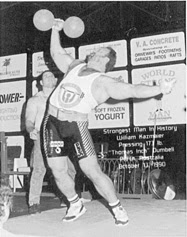
So--there you have it. A simple, basically foolproof method for moving up a few dumbbell sizes without microplates, a legion of training partners, or other shenanigans. I doubt you'll be out-pressing Kaz anytime soon, but now you have no excuse not to try....
Kaz with the Inch Dumbbell--173 pounds with a 2 1/2 inch handle.
As always, I hope you enjoyed this post and found something useful to apply to your own training. Questions and comments can be posted below or emailed to me at affectinggravity@gmail.com.
Tuesday, September 10, 2013
A sensible method for customizing training programs
Aris DeMarco
In part one of this series I outlined some of the many, many factors that intelligent individuals may wish to consider when designing their training programs: goals, time frame, limitations, personal preferences, and past experiences. In part two I gave an example from my own training showing how one can juggle some of these different factors in order to optimize your workout routines for whatever goals you have at a given time.
One of the most important things for any trainee to learn is how to properly apply their training. Doing too much will result in less progress, frustration, possible injury--in short, things going wrong. Doing too little can also result in less (or negative) progression, as well as possible injury later on, if rigorous activities are attempted in a detrained state. Plus, of course, progression is the name of the game here and more is always better. Again--more reps, heavier weights, deeper stretches, faster times or farther runs, more muscular bodyweight added or more bodyfat lost, and so forth. And a great deal of this desired efficiency and success in training progress comes as a result of not only proper planning, but proper implementation.
Prussian military officer Helmuth von Moltke is commonly credited with the quote "no battle plan survives contact with the enemy."

When it comes to properly customizing your training (if you desire to do so--and I really encourage it, at least eventually, for most individuals) you'll live by this quote. After devising a specific plan for your goals, you'll generally have to go through a period of time where you play with it a bit until you get it 'right' according to your circumstances at the time--recovery abilities, stress, amount of time to train, amount of effort you're willing to put in, and so on. Maybe you try a new training plan and think "I should do a bit more if I want to make progress." Or, perhaps after a few weeks you realize that you're pushing too hard, and have to back off. Here's a good way to think about it.
Measure your training by its frequency, its volume, and its intensity. Balance the three, adding or subtracting from each aspect as needed. Eventually, you'll get close to that 'ideal' training plan, the shortest point between where you are and where you want to be pretty soon; the plan that's specific for your goals, progressive, that contains elements you know to be effective for you, and that you enjoy doing.
Frequency: How often you do something. Want to improve your strict pullup numbers? Doing a 'daily max' set every day, or sometimes even twice daily, would be a high frequency plan.
Volume: How much of something you do, when you do do it. Let's say you realize that you need to do a lot of pullups to get better at them. Doing 100 total strict pullups every time would be a high volume program (for most people--for others, 50 or even just 20 total reps might be high volume).
Intensity: How hard you work at what you're doing. When working on your pullups, maybe you like pushing yourself really hard and going all out on every set until you're forced to drop from the bar. Doing every set all-out would be an example of high intensity.I like to define 'intensity' as a percentage of effort, though others prefer to define it solely as a percentage of your single-repetition max... more on this in the next blog entry.
So, looking at these three elements, there are clear limitations. You can't do 100 pullups, every day, with every single set taken to the point where you simply can't do any more and fall off the bar. It'd be hell on your recovery and you'd probably either stop progressing, lose gains, or get injured.

In part one of this series I outlined some of the many, many factors that intelligent individuals may wish to consider when designing their training programs: goals, time frame, limitations, personal preferences, and past experiences. In part two I gave an example from my own training showing how one can juggle some of these different factors in order to optimize your workout routines for whatever goals you have at a given time.
One of the most important things for any trainee to learn is how to properly apply their training. Doing too much will result in less progress, frustration, possible injury--in short, things going wrong. Doing too little can also result in less (or negative) progression, as well as possible injury later on, if rigorous activities are attempted in a detrained state. Plus, of course, progression is the name of the game here and more is always better. Again--more reps, heavier weights, deeper stretches, faster times or farther runs, more muscular bodyweight added or more bodyfat lost, and so forth. And a great deal of this desired efficiency and success in training progress comes as a result of not only proper planning, but proper implementation.
Prussian military officer Helmuth von Moltke is commonly credited with the quote "no battle plan survives contact with the enemy."
This dude. Looks to know a thing or two about scrapping, eh?
When it comes to properly customizing your training (if you desire to do so--and I really encourage it, at least eventually, for most individuals) you'll live by this quote. After devising a specific plan for your goals, you'll generally have to go through a period of time where you play with it a bit until you get it 'right' according to your circumstances at the time--recovery abilities, stress, amount of time to train, amount of effort you're willing to put in, and so on. Maybe you try a new training plan and think "I should do a bit more if I want to make progress." Or, perhaps after a few weeks you realize that you're pushing too hard, and have to back off. Here's a good way to think about it.
Measure your training by its frequency, its volume, and its intensity. Balance the three, adding or subtracting from each aspect as needed. Eventually, you'll get close to that 'ideal' training plan, the shortest point between where you are and where you want to be pretty soon; the plan that's specific for your goals, progressive, that contains elements you know to be effective for you, and that you enjoy doing.
Frequency: How often you do something. Want to improve your strict pullup numbers? Doing a 'daily max' set every day, or sometimes even twice daily, would be a high frequency plan.
Volume: How much of something you do, when you do do it. Let's say you realize that you need to do a lot of pullups to get better at them. Doing 100 total strict pullups every time would be a high volume program (for most people--for others, 50 or even just 20 total reps might be high volume).
Intensity: How hard you work at what you're doing. When working on your pullups, maybe you like pushing yourself really hard and going all out on every set until you're forced to drop from the bar. Doing every set all-out would be an example of high intensity.I like to define 'intensity' as a percentage of effort, though others prefer to define it solely as a percentage of your single-repetition max... more on this in the next blog entry.
So, looking at these three elements, there are clear limitations. You can't do 100 pullups, every day, with every single set taken to the point where you simply can't do any more and fall off the bar. It'd be hell on your recovery and you'd probably either stop progressing, lose gains, or get injured.

A roughly double bodyweight log lift onto a platform even just for fun was pretty much an all out effort for me (intensity). I wouldn't be able to do many of these in one day (volume), or many days in a week (frequency), no matter how much I might want to.
The basic rule of thumb here is that you can have 'high' levels of one aspect but the other two have to be 'medium' or 'light'. So, you can go all out on every set of pullups (high intensity) but maybe only twice weekly (low frequency) and for three sets (moderate volume). Or, you could do 100 total reps (high volume) three times weekly (moderate frequency) in sets of 5, when you can do 15 consecutively (low intensity--only ~30% effort). Make sense? Good, because here's the next level of complexity.
Each lift plays by different rules. I'll have another blog up in the future explaining some of the many reasons this is the case, but for every unique individual, lifts and exercises are simply... unique. They are easier or more difficult to progress in, they respond positively, in terms of progression, to different things, and can be done to different degrees when it comes to frequency, volume, and intensity. This should be pretty easy to wrap your head around--obviously, a 150-pound skinny guy is going to be able to run much more often, even if he's just starting out, than a 300-pound chubby fellow who's the same height. The light runner's ankles, knees, hips, and spine will probably be better able to deal with the new strain, for one thing. On the other hand, if our two subjects start lifting barbells, the second guy will almost definitely make better progress--his shorter limbs and thicker joints provide better leverages for many lifts and make progression easier in terms of the most weight he can move.
Zydrunas Savickas: arguably the strongest man ever lived. Probably not a great runner.
Here's where you have to experiment a bit and put your thinking cap on. Each lift and exercise and activity you do will respond a bit differently and you have to find out how to juggle them effectively. Back to the pullup example. For over a year I did weighted pullups 3 to 4 times weekly with basically all-out sets of 3 to 4 reps. This to me was moderate frequency (and high intensity and low volume). If I tried to do weighted pullups more often I'd have to drop back on frequency or volume to keep progressing. On the other hand, deadlifting 3 to 4 times a week would be VERY high frequency for me and I'd have to use stupidly light weights and easy sets to pull that often. To make your training for each goal as efficient as possible, you'll have to treat each goal as an individual entity, as long as it doesn't interfere with your other goals. This is very important. You'll have to make sure that your goals are more or less compatible with each other, as discussed in part one, if you want the best results.
Of course, if you compete in a sport things are a bit different; and balancing things out becomes even more important. For a particular powerlifter, squatting thrice weekly might be the best thing he could ever do for his squat. But he also has to train his bench press and deadlift regularly so 3x/week squatting is out, except maybe for specialization periods between competitions. Another example--a football team has to get strong in the weight room, but during the season their plays rough the team up too much to add big poundages to their lifts. Thus, many teams go heavy in the offseason when they don't have to worry about hard practices and harder games on top of time with the weights.
Balance is important.
So, quick summary here:
1. Think about your training in terms of frequency, volume, and intensity
2. Remember that each lift, exercise and activity will have different levels corresponding to 'high', 'low', and 'medium', in terms of #1.
3. Balance things out, and ensure that your goals are more or less compatible.
4. Be reasonable. This also goes back to part one (link up top). You'll have to make a lot of sacrifices if you want to jack up the volume, frequency, and intensity simultaneously (using the smolov squat program, for example). Don't try to do everything at once. Your training should make sense.
5. Keep the other stuff in mind--specific goals, doing what you enjoy, all that good stuff.
I'll probably have an article concerning another subject (either 'simple progressions' or another historical 'lifter profile') up next. But keep an eye out for the next entry in the program design series--I'll write about how to measure intensity (and why), why it's best to look at lifts individually, and other good stuff.
As always, hope you enjoyed the article! Drop me a line at affectinggravity@gmail.com, or comment below with any questions.
Friday, August 23, 2013
Simple progression part 2: Circuits
Aris DeMarco
part 1
In an effort to continue with the 'training information for the everyman' nature of this blog, I've written up the second part of my 'simple progression' series. Basically, this is for guys with minimal equipment (i.e. pullup bar, maybe a few dumbbells, etc.) who want to improve strength and conditioning as efficiently as possible, while taking minimal time out of their busy days.
Part one was all about increasing your one-set max repetitions. However, an approach like that might leave your work capacity wanting when it comes to multiple sets. Plus, overall conditioning is generally improved by, well, being active longer--so you need a way to compress a lot of work (multiple sets) into a short amount of time. Enter circuits.
Basically, a circuit is a series of exercises done in succession, for multiple rounds. Thus:
exercise 1
exercise 2
exercise 3
exercise 1
exercise 2
...and so forth. Some people advocate resting after each 'round', or between exercises, others don't. One option is to do a set number of repetitions for each exercise, each round, and repeat for as many rounds as possible in a given time frame. Ross Enamait's 'work capacity 101' conditioning workout uses that format:

part 1
In an effort to continue with the 'training information for the everyman' nature of this blog, I've written up the second part of my 'simple progression' series. Basically, this is for guys with minimal equipment (i.e. pullup bar, maybe a few dumbbells, etc.) who want to improve strength and conditioning as efficiently as possible, while taking minimal time out of their busy days.
Part one was all about increasing your one-set max repetitions. However, an approach like that might leave your work capacity wanting when it comes to multiple sets. Plus, overall conditioning is generally improved by, well, being active longer--so you need a way to compress a lot of work (multiple sets) into a short amount of time. Enter circuits.
Basically, a circuit is a series of exercises done in succession, for multiple rounds. Thus:
exercise 1
exercise 2
exercise 3
exercise 1
exercise 2
...and so forth. Some people advocate resting after each 'round', or between exercises, others don't. One option is to do a set number of repetitions for each exercise, each round, and repeat for as many rounds as possible in a given time frame. Ross Enamait's 'work capacity 101' conditioning workout uses that format:
Not quite doing full deadhang pullups here, but we can forgive him that--he's Ross.
As you can see, you have a few different variables to play with: exercises/lifts used, repetitions done, number of rounds, or amount of time the workout takes. Doing the exercises one after the other keeps your heart rate up and improves your overall conditioning, and doing multiple sets of each exercise with relatively short rest periods (doing the other exercises in the circuit) improves your muscular endurance. Given the great amount of work done relative to time taken up, it's possible to get an excellent full body workout in 20 to 30 minutes. Progression is simple. Use more difficult exercises in the circuit, do more rounds total, do more rounds without stopping, or do more total repetitions for each exercise.
As far as exercise choice goes, it's a good idea to pick 4-5 movements that 'cover' your entire body.
Upper body pushing--pushups, dips, handstand pushups, one arm overhead presses or push presses
Upper body pulling--pullups, chinups, horizontal rows, one arm dumbbell rows
Lower body pushing--squats or squat jumps, lunges, pistol squats or progressions thereof
Lower body pulling/hip extension--hyperextensions, glute bridges, glute-ham raise progressions, db or kb swings
Midsection/core--lying or hanging leg raises, ab wheel rollouts, 'windshield wipers'...
...there are plenty of possibilities, those are just a few examples. Obviously, depending on exercise choice, your circuits can range from a strength to an endurance focus. Resting in between exercises or rounds can help you get more repetitions in, but of course, the workout will take more time. One thing you can do is add a sixth 'active recovery' movement, say, jump rope or light jogging in place, for 1-2 minutes at the end of every round. That way, all your muscles can get a bit of extra rest, but your heart and lungs are still working.
Here are a few circuits I used several years back. At the time, I'd just quit running track for the first time due to foot/ankle issues but wanted to improve both my strength and endurance along with general cardio conditioning. All I had was a pullup bar and a pair of kettlebells.
Workout 1:
pushups
horizontal bodyweight rows
bodyweight 'free' squats
kettlebell swings-16kg
lying leg raises
--all done without rest between exercises or rounds, for 20-40 reps each exercise, for 5-10 rounds
Workout 2:
Handstand pushups (on the floor, against a wall)
Pullups to one side
Pistol squats
kettlebell swings-24kg
situps on the floor, 10lb plate behind head, feet unsupported
--all done without rest between exercises or rounds, as many repetitions as possible without pausing or stopping, for 5 rounds. Keep track of total reps done in 5 rounds and try to improve on that number.
The pistol squat--a very solid exercise overrated by some, underrated by many others
I alternated between the two workouts 3-5 days each week. This was a tremendous workload, at the time, far greater than any I had experienced before. After the first week or so, the initial soreness had decreased to the point that I could train more or less daily, alternating between my 'strength' and my 'endurance' circuit. After a couple of months, I managed to do more than 10 handstand pushups for the first time, 20+ full pistol squats with each leg, and was averaging 250-300 very strict pushups, each several times per week. I tested myself on a 1 mile run and broke the 6-minute mark for the first time while on this routine, without doing any running.
Circuit training is fantastic for those with limited equipment and time. Bodyweight, kettlebells, sandbags; virtually any tool (or none at all) can be used. Routines are simple to design and easy to implement, and results tend to come quickly. Thus, circuits are an excellent format for busy individuals who want a bit of everything in their workouts but don't have a lot of time to work for it.
...The next post in the 'simple progression' series will be the first of many articles I'm writing about density training--but first, I'll put up the next piece in the lifter profiles series.
You can leave comments and questions below or send them to affectinggravity@gmail.com, and watch our youtube vids here.
Friday, August 2, 2013
Creating the perfect training routine, part 2: the triple bodyweight deadlift
Aris DeMarco
In part one, I wrote about the general factors you should consider when designing a specific training program, regardless of what your goal(s) are. Here's a detailed example; a recent program of mine that got me to my first triple bodyweight deadlift.
Setting the goal:
After joining the strongfirst deadlift team, I of course began thinking of our competition and wanted to put up a good number on the platform. About two months before the meet, my best deadlift was 395. The goal I settled on was simple--add 15+ pounds to my deadlift 1RM in 8 weeks. I'd been hovering around a 2.5-2.75x bodyweight pull for some time, and figured that my first powerlifting meet would be a good place to smash through the triple bodyweight barrier and break through into the 400s. Plus, a triple bodyweight lift would be a state record in the IPA, albeit an unofficial one (as it would not be done in a full power meet).
Limitations:
I had some severe limitations at this time. I trained at home, and my mismatched plates, knurling-deficient bar and uneven basement floor didn't exactly provide great lifting conditions. Also, I'd be recovering without the very high protein, high calorie diet of the all-you-can-eat meal plan I enjoyed while at school. Thus, I had to take steps to adapt. First off, because I was training under less than ideal conditions with only 8 weeks to go before the meet, any sort of pre-planned periodization cycle would be ill advised at best.

Sacrifices:
Given my recovery limitations and the fact that I really wanted to work as hard as possible on deadlifts, I decided to cut all 'unnecessary' exercises out of my training. Ideally, of course, I'd do some sort of pullups, rows, hyperextensions, shrugs, or whatnot to help boost my deadlift; or include squats or presses to balance out my routine, but I decided that wasn't necessary to improve my pull. I'm built pretty decently for the deadlift and can gain well on it just by doing it. So deadlift I did, and... for 7 weeks that's all that I did.

215x2, 245x2; 235x2, 265x2; 215x2, 285x2; 255x2, 285x2, 305x2
*I tried to increase the weight I could lift in 1 second, videotaping many sets in order to time the lifts. I pulled from a low pause because it wasn't as rough on my recovery. I don't have a video of this, but I slowly squeezed the bar off the floor about an inch, paused, and snapped it to lockout from there; a 'standing start', if you will.
Day 2
Ramp up to a top set of 3-5 belted deadlifts, or a top double-paused DL single. I often followed the double-paused pulls with a set of 5-10 RDLs, e.g.
Double pause DL 135x5, 215x1, 265x1, DL 305x1, 335x1, double pause DL 365x1, RDL 215x5, 285x10
*Double pause deadlifts were done with a short pause just off the floor, and another at the knee. This was to take away my momentum completely and force me to grind the lift all the way through instead of relying on my speed.

In part one, I wrote about the general factors you should consider when designing a specific training program, regardless of what your goal(s) are. Here's a detailed example; a recent program of mine that got me to my first triple bodyweight deadlift.
Setting the goal:
After joining the strongfirst deadlift team, I of course began thinking of our competition and wanted to put up a good number on the platform. About two months before the meet, my best deadlift was 395. The goal I settled on was simple--add 15+ pounds to my deadlift 1RM in 8 weeks. I'd been hovering around a 2.5-2.75x bodyweight pull for some time, and figured that my first powerlifting meet would be a good place to smash through the triple bodyweight barrier and break through into the 400s. Plus, a triple bodyweight lift would be a state record in the IPA, albeit an unofficial one (as it would not be done in a full power meet).
Limitations:
I had some severe limitations at this time. I trained at home, and my mismatched plates, knurling-deficient bar and uneven basement floor didn't exactly provide great lifting conditions. Also, I'd be recovering without the very high protein, high calorie diet of the all-you-can-eat meal plan I enjoyed while at school. Thus, I had to take steps to adapt. First off, because I was training under less than ideal conditions with only 8 weeks to go before the meet, any sort of pre-planned periodization cycle would be ill advised at best.
Not exactly the Russian camp at Taganrog...
Sacrifices:
Given my recovery limitations and the fact that I really wanted to work as hard as possible on deadlifts, I decided to cut all 'unnecessary' exercises out of my training. Ideally, of course, I'd do some sort of pullups, rows, hyperextensions, shrugs, or whatnot to help boost my deadlift; or include squats or presses to balance out my routine, but I decided that wasn't necessary to improve my pull. I'm built pretty decently for the deadlift and can gain well on it just by doing it. So deadlift I did, and... for 7 weeks that's all that I did.

Personal enjoyment:
This was pretty straightforward. The deadlift is one of my favorite lifts, and I was perfectly content doing nothing else for almost two months. Meet prep was frustrating at times, especially when my basement flooded and I had to wear rubber boots to lift, but my eventual progress was definitely worth any temporary lack of my usual zeal for training.
An effective approach:
Over the past couple of years, I'd come to notice that moderate frequency, low to moderate volume, high intensity training was best for my deadlift. Working up to a top set of varying reps every 4-7 days or so really seemed to be the best course. I decided to stick with those basic guidelines (moderate frequency, fairly low volume, high intensity) when planning my prep program for this meet.
Regarding my deadlift itself, speed off the floor is definitely my strong suit and lockout is my weak point. Generally, I rip the bar off the floor and try to blow through most of the sticking point with momentum from a fast start, then grind the rest of the way to lockout. I decided to alternate sessions in which I spent a lot of time developing speed, with sessions developing grinding strength and lockout power. So:
Day 1
Beltless speed pull doubles in 2 or 3 progressive waves of 2-4 sets, for example:215x2, 245x2; 235x2, 265x2; 215x2, 285x2; 255x2, 285x2, 305x2
*I tried to increase the weight I could lift in 1 second, videotaping many sets in order to time the lifts. I pulled from a low pause because it wasn't as rough on my recovery. I don't have a video of this, but I slowly squeezed the bar off the floor about an inch, paused, and snapped it to lockout from there; a 'standing start', if you will.
Day 2
Ramp up to a top set of 3-5 belted deadlifts, or a top double-paused DL single. I often followed the double-paused pulls with a set of 5-10 RDLs, e.g.
Double pause DL 135x5, 215x1, 265x1, DL 305x1, 335x1, double pause DL 365x1, RDL 215x5, 285x10
*Double pause deadlifts were done with a short pause just off the floor, and another at the knee. This was to take away my momentum completely and force me to grind the lift all the way through instead of relying on my speed.
Terrible video quality, but you get the idea
And... there you have it. I designed a program based around 1. my very clear goal, 2. what had worked for me in the past, and 3. my training conditions (and limitations) at the time; trained very hard, and was successful. My deadlift went from 395 to 412.5 in 8 weeks.
Other stuff...
As I anticipated (though I did hope--and try--to prove myself wrong) I was unable to pull a really good top single in training; failing with 375 and 385 several times... quite stupid, really. The biggest weight I moved during prep was 365. I did manage 360x4 about two and a half weeks out from the competition, and that let me know that I was on target. Simply put, the strength I built could not be demonstrated well under training conditions.
As far as tapering for the meet went, I just worked very very hard and then took the week off before competing. Doing only one lift, I chose my first two attempts very conservatively (360 and 385) so that I'd have plenty of energy to go all-out on my third; a strategy that paid off.

The lift I wanted to make before I even started lifting....
As always, I hope this blog was informative (and didn't bore you to death!) --I'll have the next posts for the old(e)time strongman series and the bodyweight progressions series up before too long.
You can leave comments and questions below or send them to affectinggravity@gmail.com, and watch our youtube vids here.
Sunday, July 28, 2013
Creating the perfect training routine
Aris DeMarco

In my blog entry here, I mentioned the importance of finding a 'best thing', routine-wise, at any given point in time in your training; a straight line between you and your goals that, however short, will help you progress efficiently. Program design is really all about logic and common sense--put a bit of thought into it and making gains will be much easier.
Your thought process should be pretty simple:
1. What are my goals?
Basically, what do you want to get done? (Numbers are good here--more reps, more weight, faster time, longer distance, bodyweight gained/lost, and so forth.) Also, how should you prioritize your goals, if you have more than one? Of course, if you have multiple goals, it's probably a good idea to make sure that they're synergistic to some extent. Losing ten pounds and adding 5 reps to your best set of strict pullups? Sure. Training to complete your first marathon while putting 50 pounds on your front squat max? Not such a good idea.
2. When do I want to achieve them by?
This one comes down to common sense and balance, just like #1. Sure, everyone wants to add a plate to their max bench, but it ain't gonna happen overnight, and if you're due to travel in two months and won't have gym access for a while you have to set up your plans accordingly. Also, the faster you want to achieve one goal, the more you'll have to let other things go while working at it, which brings us to....
3. What am I willing to sacrifice?
This is an important one. Obviously, unless you're a professional athlete you probably don't want to progress in your training at the expense of a social life, work, general health, etc. But if you're running smolov (for example) you might have to get a few extra hours of sleep a night, spending less time doing other things; or spend more money on food, or whatever else you need to do in order to enhance your recovery.
Another consideration here is your other lifts. Taking the example from #1, if you want to drastically increase your running ability, general fatigue in your hips/knees/ankles will probably hold you back on squats for a while. Whether you're willing to sacrifice max squatting ability for running endurance is up to you. The more varied your goals are, and the busier your day to day life is, the more your training might end up looking like this:

...but that's just the way things go.
4. What is most effective for me?
This is big, of course, when you're considering efficient training. After a few years of experimenting with various programs, you'll learn what's most effective for you. This has to be taken into consideration with everything else, of course. Using the example from #2, a traditional 12 or 16-week powerlifting cycle might be most effective for your bench. However, if you only have 2 months before going on your trip, you obviously can't fit that in, so another plan is necessary.
5. What do I enjoy the most?
For the vast majority of people, training is for either health, aesthetic purposes, or personal enjoyment (or some combination of those three). Yeah, everyone wants 'functional strength' too, but let's be real here: The most functional thing we could do in today's world is progressively adding weight to our dinner utensils, tv remote, and cell phone.
Personal enjoyment is important because you'll be more likely to focus, you'll be more enthusiastic about training, and, of course, you'll like it. I read something recently about a few guys who competed in geared powerlifting--they hated training in bench shirts. The shirts were uncomfortable, a hassle to get on and off, and the poundages gained from putting the shirts on weren't very rewarding. The guys weren't getting paid to compete, or breaking any substantial records, so... if they didn't enjoy it, why were they doing it? Beats me.
6. What is limiting me?
Finally, you have to consider limiting factors. Flexibility can be an issue if you want to perform certain lifts, for example. A rough work schedule, sleep issues, a physically demanding job, frequent travel, negativity from friends and family, old or new injuries, dietary restrictions, less-than ideal training conditions... the list of possibilities goes on, but all these must be taken into consideration. If your recovery is inadequate, reduce training volume, or frequency, or intensity. If you have a physical weakness, fix it, or work around it... or with it. Ensure that you have a base in place--don't try to work up to doing one-arm chinups when you can barely do 15 half-assed reps with two arms. Don't try to squat like an olympic lifter if you can't hit powerlifting depth without weight. And so forth.
In short--
-Define what you want to achieve
-Think carefully about your current situation and limitations
-Apply your past experiences and knowledge of yourself and what works for you
-Design a sensible, efficient, specific training routine to attain your goals
-Have at it.
It really is that simple. In the next 'program design' blog I'll give a real-world example or two of my own; after that I'll write about finding the balance between doing too much, and too little.
In short--
-Define what you want to achieve
-Think carefully about your current situation and limitations
-Apply your past experiences and knowledge of yourself and what works for you
-Design a sensible, efficient, specific training routine to attain your goals
-Have at it.
Better get started, he's way ahead of you.
...do I need an excuse to post this? No? Thought not.
It really is that simple. In the next 'program design' blog I'll give a real-world example or two of my own; after that I'll write about finding the balance between doing too much, and too little.
Subscribe to:
Comments (Atom)